About Dubai
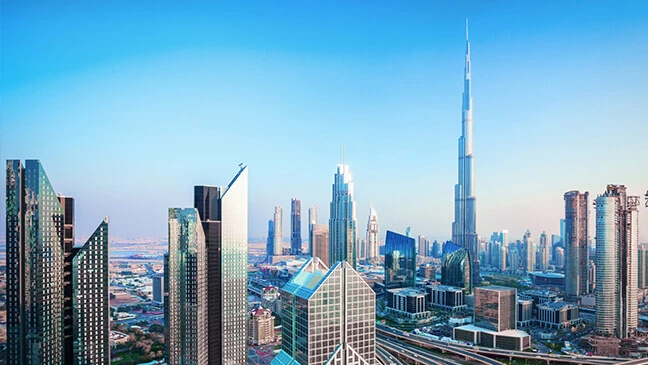
Dubai's population passed 4 million in 2025, and the city keeps drawing newcomers for work, business, family life, and long-term residency. The reasons vary – a new job, a company registration, reuniting with relatives already settled here, or simply the search for a better quality of life – but the outcome is the same: one of the fastest-growing cities in the Gulf, with forecasts pointing toward 4.7 million residents by the end of 2026. What started as a trading and pearling port has grown into a global hub for finance, tourism, logistics, and technology, and that diversification is a big part of why the city has kept attracting residents and investors through several economic cycles.
For property buyers, Dubai offers tax-free rental income, no capital gains tax, and full foreign ownership in designated freehold areas – rules that put it ahead of most competing global cities on paper returns alone. The choice of property is just as wide, running from studio apartments in Jumeirah Village Circle to branded villas on Palm Jumeirah and everything in between. The market has kept pace with the population: Dubai recorded more than 200,000 residential transactions in 2025, and the IMF projects UAE GDP growth of around 5% in 2026, among the fastest in the region. Rental yields typically run between 5% and 8% depending on property type and location, and price growth is moderating into 2026 after several years of rapid appreciation – a sign of a market settling into a steadier, more sustainable pace rather than cooling off.
Living in Dubai comes with a level of infrastructure and safety that's hard to match regionally: a metro network that keeps expanding, one of the world's busiest international airports, low crime rates, and a school and healthcare system built around a large expat population. The lifestyle side holds up too – beaches, desert on the doorstep, a dining scene that spans the world, and a calendar built around shopping festivals, sports events, and entertainment that runs through the cooler months. None of it requires giving up convenience; Dubai is compact enough that most of the city is a short drive from most of the rest of it.
Dubai's Golden Visa programme adds a further reason to buy rather than rent long-term: property owners above a set value threshold can qualify for a renewable 10-year residency visa, decoupled from employment. Combined with the city's tax position and its Dubai 2040 Urban Master Plan – which lays out continued investment in transport, green space, and new residential districts – it's a market built for people planning to stay, not just pass through.
Have a question?
Our team is happy to assist you
or Call: (+971) 44 55 8888
Frequently Asked Questions
Tax-free rental income, no capital gains tax, freehold ownership for foreigners in designated zones, steady population growth, and rental yields that hold up well against most global cities.
Downtown Dubai, Dubai Marina, Palm Jumeirah, Business Bay, and Dubai Hills Estate lead on prestige and resale demand, while Jumeirah Village Circle and Dubai South are popular for more affordable entry points with strong rental yields.
Yes. Non-UAE nationals can buy freehold property in designated areas across Dubai with full ownership rights, and can apply for a residency visa linked to the property's value.
It's a long-term residency scheme. Investors who buy property above a set value threshold can qualify for a renewable 10-year visa rather than the shorter visas tied to employment.
Market data from early 2026 points to steady rather than explosive growth. Price appreciation is moderating, but transaction volumes and rental yields remain strong, supported by continued population growth and GDP expansion.
No. The UAE does not levy income tax or capital gains tax on individuals, which is one reason Dubai property stays attractive to international investors.