Is Palm Jebel Ali the Next Palm Jumeirah, or a Different Kind of Bet?
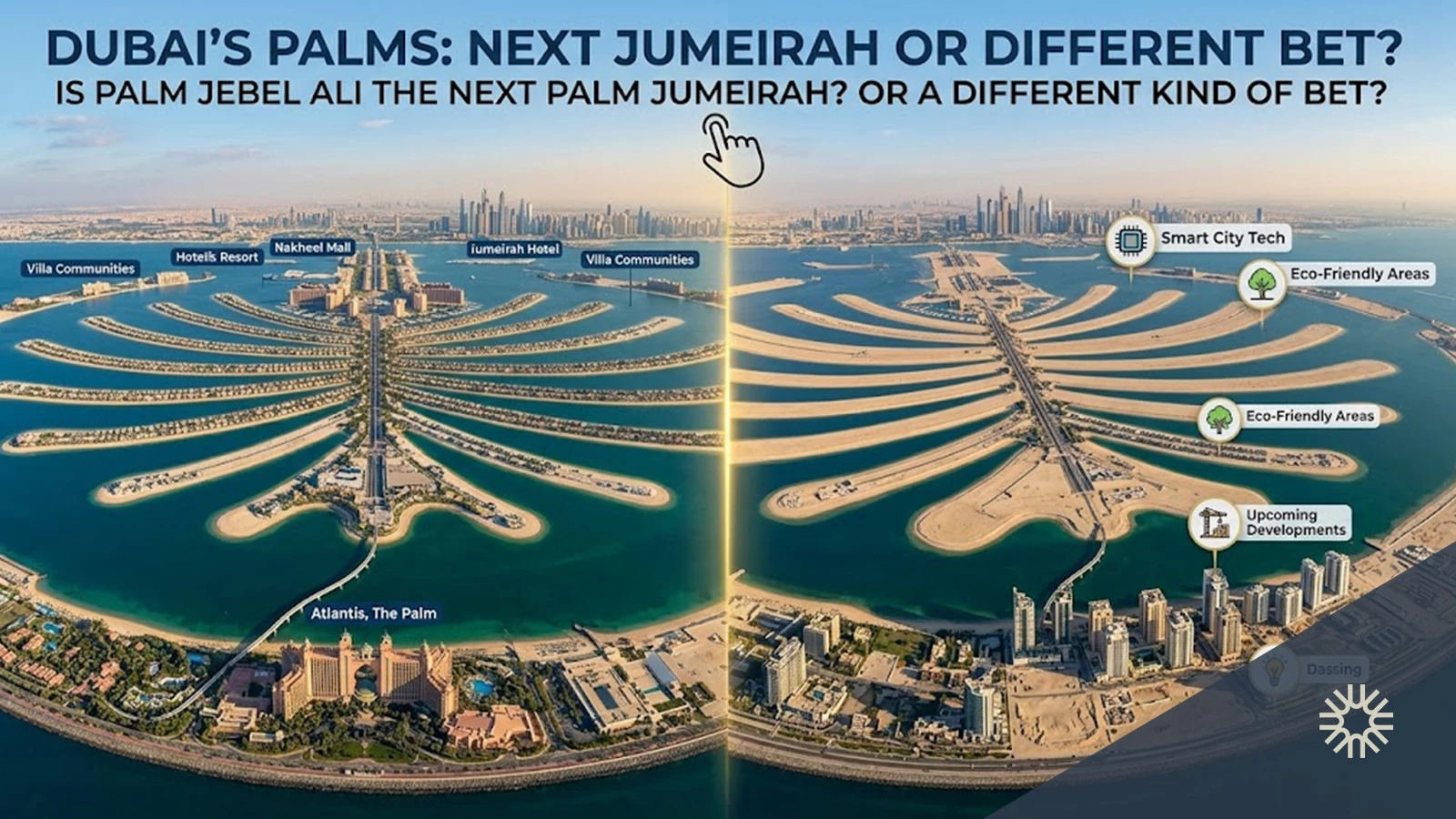
Every few months, someone in our office asks the same question in a different accent: "Is Palm Jebel Ali just Palm Jumeirah, take two?" It's a fair question. Same developer, same palm shape, same stretch of Arabian Gulf. But the more transactions we walk clients through, the more we think this comparison misses the point. These are not two versions of the same product. They're two different bets on Dubai, and the numbers back that up.
What the Data Actually Shows
Let's start where the decisions get made: price per square foot.
According to Dubai Land Department transaction records, villas on Palm Jebel Ali are currently trading around AED 2,600 to 2,692 per square foot, depending on the unit's bedroom count. Property Finder's own listings data puts the average across the whole island near AED 3,300 per square foot once apartments and land are folded in.
Palm Jumeirah, for comparison, sits at roughly AED 4,016 per square foot as of April 2026, per Property Finder's transaction data, with signature villas ranging from AED 3,500 to AED 6,000 and select renovated frond villas pushing past AED 8,000. That's not a small gap. It's a discount of somewhere between 45 and 65 percent, depending on which segment you're comparing.
Here's the detail we think gets buried too often: Palm Jebel Ali's five-bedroom villas run about 53% larger than their Palm Jumeirah equivalents, at roughly 8,332 sq ft versus 5,457 sq ft, while still costing around 45% less in absolute price. You're not just paying less per square foot. You're buying more square footage, full stop.
Since sales reopened in October 2023, Palm Jebel Ali has logged AED 35.1 billion in transaction volume across 1,632 deals, based on DLD figures. That's a serious amount of capital committing to a project that, as of last October, was only around 8.7% built. Frond O is furthest along at just under 22% completion. That gap between money in and concrete poured is exactly why this isn't a like-for-like comparison to Palm Jumeirah.
Same Developer, Very Different Clock
Palm Jumeirah has been a finished, lived-in address since 2007. It houses roughly 80,000 residents today. When you buy there, you're buying a villa or apartment that exists, with a view, a garden, and a neighbor next door who's owned it since the early days. Most of that stock is resale, and resale on Palm Jumeirah usually means full payment on transfer.
Palm Jebel Ali is still mid-construction. Nakheel is offering an 80/20 payment structure on villas and apartments there, meaning a buyer commits to a plot but keeps the bulk of their capital until later milestones. Core infrastructure is targeted for completion by the fourth quarter of 2026. The first wave of handovers, 325 units across Fronds I, J, M, and P, is expected by late 2027. The larger chunk of the island, around 746 units spread across Fronds A, C, D, E, F, and O, is pencilled in for 2028, with the final phases stretching to 2029 or 2030.
So when someone asks if Palm Jebel Ali is "the next Palm Jumeirah," our honest answer is: it's Palm Jumeirah's land bank at Palm Jumeirah's construction-year prices, with a multi-year wait attached. That wait is the trade-off, and it's the whole reason the discount exists.

Space Is Doing a Lot of the Selling
Palm Jebel Ali is being built roughly 50% larger than Palm Jumeirah, with close to 90 km of added coastline. Plot sizes on the new island reflect that. Villas typically start above 7,400 sq ft, with some plots reaching 15,000 sq ft, well beyond what most Palm Jumeirah fronds ever offered even at launch. Land plots for private builds start around AED 25 million and average closer to AED 69 million, against a nationwide land average of roughly AED 4.3 million, which tells you exactly which buyer this project is built for.
That's not a coincidence. Nakheel learned something from twenty years of running Palm Jumeirah, where density crept up frond by frond as smaller lots got infilled. Palm Jebel Ali's masterplan bakes in lower density and bigger setbacks from the start. Whether that holds as phases 2 and 3 come to market is something we're watching closely, and we'd encourage any serious buyer to watch it too.
What This Actually Means If You're Deciding Between the Two
If your priority is a home you can move into this year, with established beach clubs, a functioning monorail, and neighbours already unpacking their furniture, Palm Jumeirah is still the only real answer. Rental yields there run 3.5% to 6.5% depending on villa type, and values were up close to 14% year-on-year through early 2025. It's a mature, liquid market, and liquidity has a price.
If your priority is entry pricing, larger plots, and multi-year capital appreciation ahead of a 2027-2030 handover schedule, Palm Jebel Ali is the more interesting off-plan story on the market right now. Both projects clear the AED 2 million threshold for Golden Visa eligibility, so residency isn't a differentiator here. Construction timeline and holding period are.
Our Take
We don't think Palm Jebel Ali needs to become "the next Palm Jumeirah" to be a good buy. It's a bigger island, a longer runway, and a different kind of patience test. Palm Jumeirah earned its premium over two decades of people actually living there. Palm Jebel Ali is asking buyers to price that premium before it exists. Some of our clients want that early entry. Others would rather pay more today for something they can walk into tomorrow. Neither instinct is wrong, but they lead to two very different properties.
If you're weighing these two islands against your own numbers, our team can walk you through live listings, payment plans, and frond-by-frond pricing on both. View Properties on Palm Jumeirah and Palm Jebel Ali through our Find a Property page, or Book a Consultation with one of our advisors to map out which timeline actually fits your goals.