Why Demand Is Moving Toward Self-Sufficient Communities Across Dubai
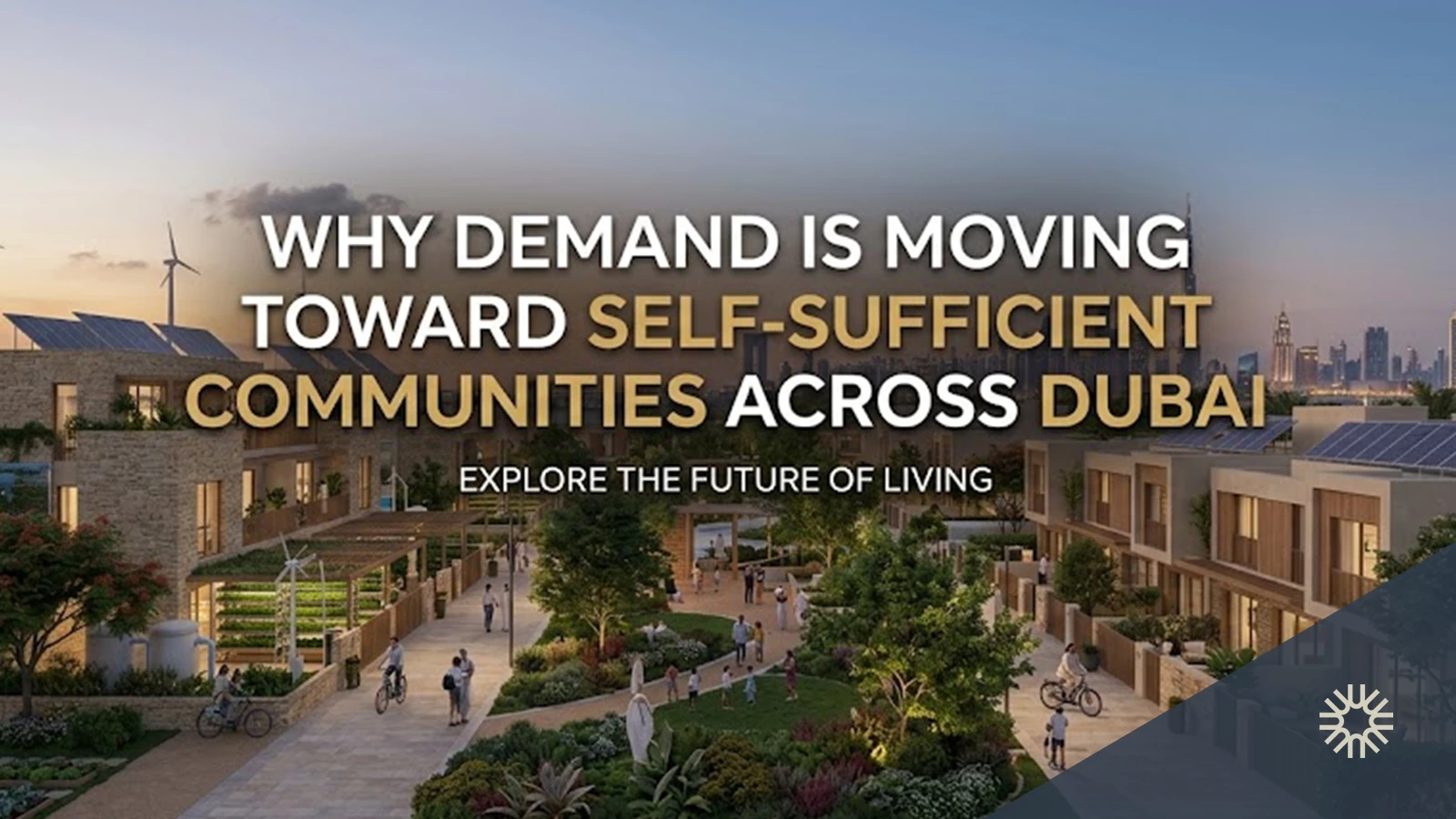
A few years ago, "location" meant proximity to Downtown or the Marina. Today, at Unique Properties, we're seeing that phrase get redefined by our own clients. Location now means the school run takes eight minutes, the clinic is inside the gate, and the nearest supermarket doesn't require getting on Sheikh Zayed Road at all. That's the pull of the self-sufficient community, and the numbers back up what we're hearing on the ground.
The Shift Is Visible in the Data, Not Just the Viewings
We used to explain this trend to clients using anecdotes: a family moving from Downtown to Dubai Hills Estate for the garden, an investor asking specifically about Tilal Al Ghaf because their tenant wanted a lake view without a lake-view price tag. Now we can point to the transaction data instead.
Property Finder's 2025 market figures show that four-bedroom-plus villas made up 62% of all villa transactions last year, up from just 38% three years earlier. That's not a marginal shift. It means the buyer profile for villas has changed almost entirely, from investors chasing yield to families who plan to actually live there, long term, with kids who need a bedroom each and a place to do homework that isn't a hallway.
Villa prices reflect that appetite. They climbed roughly 14% year-on-year in 2025, more than double the 6% growth seen in apartments. And it's happening despite limited new villa supply, which tells us the demand is structural rather than a short-term reaction to a single project launch. Around 72% of these villa deals sat in the AED 1,000 to 1,800 per square foot range, the mid-market band where most of our own buyers are shopping. This isn't a story about ultra-luxury alone. It's a story about ordinary families deciding that a self-contained neighborhood is worth paying up for.
Established Master Communities Are Ageing Well
Here's something we find genuinely interesting, and it doesn't get talked about enough: the communities gaining the most in 2025 and into 2026 weren't the newest ones. Mature master-planned neighborhoods like The Meadows recorded annual capital gains north of 34%, while Victory Heights and The Lakes both cleared 30%. These are communities that have had a decade or more to grow their trees, settle their schools, and prove their retail centers actually work day to day. Buyers are rewarding that track record.
We think this matters for anyone weighing off-plan against ready. A brand-new master plan can promise a lake, a school, and a wellness center on a brochure. A community like Mudon or Al Furjan can show you the school run happening right now. That difference is increasingly showing up in price.
Population Growth Is Doing a Lot of the Work
Dubai's resident population passed the 4 million mark in 2025, with the city's active daytime population edging closer to 6 million once you count the workforce that commutes daily. The Dubai 2040 Urban Master Plan is targeting 5.8 million permanent residents, which means this isn't a temporary bulge, it's a planning assumption baked into how the city is being built.
More residents, and specifically more families choosing Dubai as a long-term base rather than a posting, means more demand for neighborhoods that function like small towns. Rental data supports this too. Villa rents rose about 11% in 2025, outpacing apartment rents at roughly 5%, and renewals made up 62% of all rental contracts registered across the city. People aren't just moving into these communities. They're staying.

What "Self-Sufficient" Actually Means to Our Buyers
When we sit down with clients now, self-sufficiency isn't an abstract lifestyle pitch, it's a checklist. An international school inside or immediately next to the community. A clinic or hospital within a five-minute drive. A retail strip or town center that covers groceries, a pharmacy, and a coffee run without leaving the gates. Green space that isn't just landscaping around a sales center but an actual park where kids can be unsupervised for twenty minutes.
Areas like Dubai Hills Estate, Arabian Ranches, and The Valley keep coming up in our conversations for exactly this reason. They're not marketed as investment products first. They're marketed, and increasingly bought, as places to build a life.
Where We Think This Is Heading
Based on what we're seeing in our own listings and in the wider transaction data, we expect the gap between self-sufficient master communities and standalone towers to widen before it narrows. Roughly 120,000 new residential units are scheduled for handover across Dubai in 2026, and a meaningful share of that pipeline sits inside integrated communities rather than single-building developments. Supply is catching up with demand, but the demand curve keeps moving too, so we're not expecting a sudden softening in this segment.
For investors, the read is straightforward: these communities carry near-zero vacancy because family tenants don't move often, and turnover costs stay low as a result. For end users, the read is even simpler. If you've been priced out of a villa in an established community, waiting rarely helps, because these neighborhoods tend to appreciate ahead of the wider market, not behind it.
Talk to Someone Who Tracks This Daily
We spend our days inside these communities, not just analyzing them from a spreadsheet. If you're weighing an established neighborhood against a new master plan, or trying to work out which self-sufficient community fits your budget and your commute, our team can walk you through the real numbers behind each option.
View Properties in Dubai's leading self-sufficient master communities, or book a consultation with a Unique Properties advisor to get a shortlist built around your actual needs, not a generic brochure.